Soft Pastels vs. Oil Pastels: Which Medium Is Right for Your Next Masterpiece?
- Share
- Issue Time
- Jul 30,2026
Summary
A comprehensive comparison of soft pastels and oil pastels covering texture, blending, surface compatibility, lightfastness, and application scenarios for artists, educators, and OEM buyers.
Why the Pastel Choice Matters More Than You Think
Walk into any art supply store or browse a B2B catalog and you will find two distinct pastel categories: oil pastels and soft (dry) pastels. To a casual observer they look similar — colorful sticks in boxes. But to a working artist, educator, or art supply buyer, the choice between them determines everything: the paper you use, the blending techniques available, the final look of the artwork, and even the shipping and storage requirements. For OEM brands and distributors, understanding the technical differences between these two mediums is essential for building a catalog that meets diverse customer needs and avoids the costly mistake of ordering the wrong product for your target market.
The Fundamental Difference: Binder Chemistry
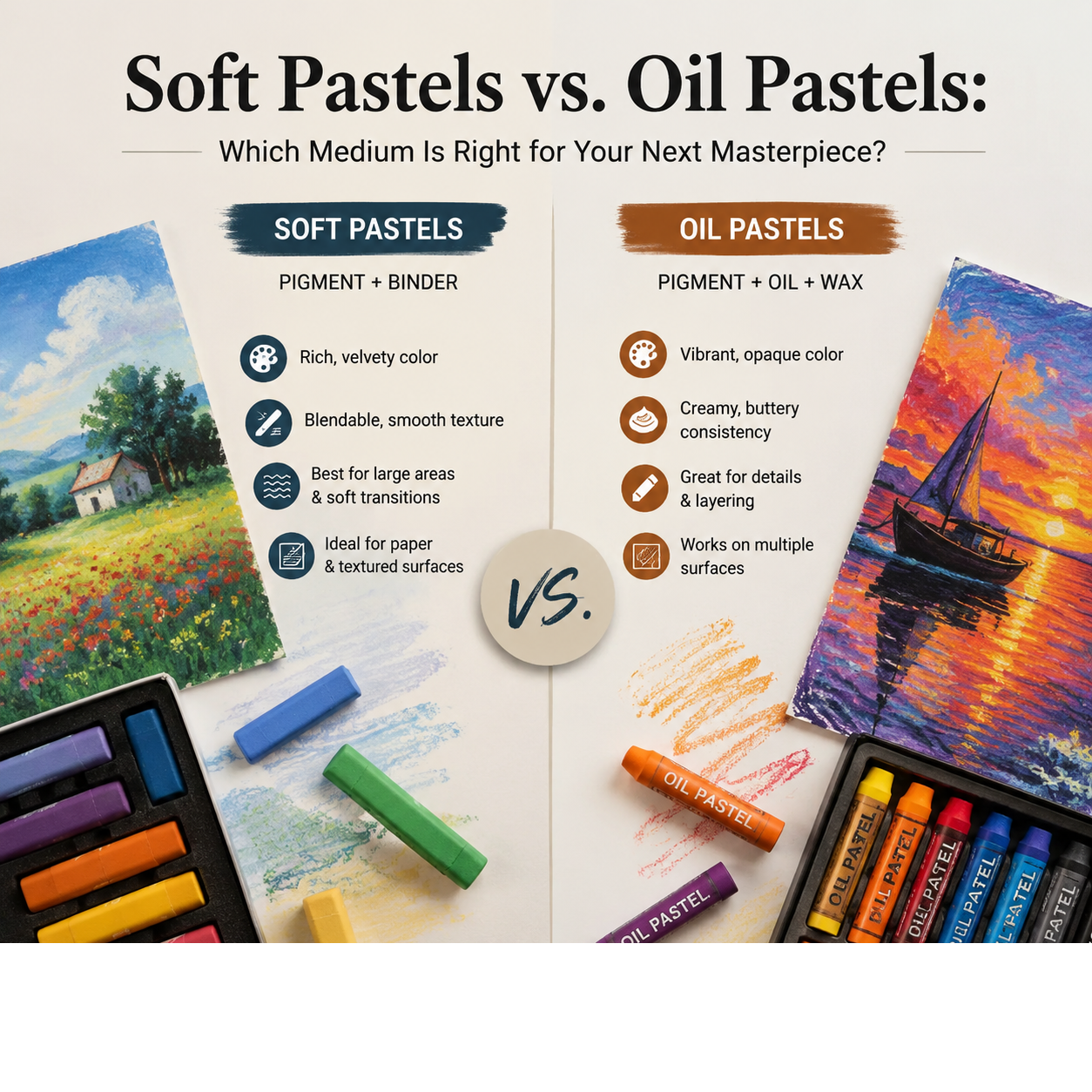
The defining difference between oil pastels and soft pastels lies in their binder — the substance that holds the pigment together in stick form. Oil pastels use a non-drying oil and wax binder, giving them a creamy, dense texture that never fully dries or hardens. This makes them water-resistant and durable, but also means they can smudge if not properly protected. Soft pastels use a minimal amount of gum tragacanth or methyl cellulose binder, resulting in a dry, powdery stick with an extremely high pigment-to-binder ratio — typically 90-95% pure pigment. This gives soft pastels their signature velvety texture and unmatched color intensity, but also makes them fragile, dusty, and requiring fixative to preserve the finished work.
Texture and Application: Creamy Canvas vs. Powdery Paper
Oil pastels feel like drawing with a lipstick or crayon — they glide smoothly across most surfaces with minimal resistance, depositing rich, opaque color in broad strokes. They are excellent for covering large areas quickly and work well on canvas, wood, and even glass. Soft pastels feel more like drawing with pure pigment dust compressed into a stick — they drag slightly on textured paper, creating a characteristically soft, atmospheric result that can be smudged and blended with fingers or blending stumps. The experience is more akin to painting than drawing, and the best results come from using specialized pastel paper with enough 'tooth' to grip the pigment particles.
Blending Techniques: The Artist's Toolbox
Oil pastels blend through physical manipulation — layering colors and using tools like blending stumps, tortillons, cloth, or even turpentine and mineral spirits for a painterly wash effect. Once blended, oil pastel colors tend to stay where they are placed. Soft pastels blend effortlessly with just a finger, producing seamless gradients that are nearly impossible to replicate with any other dry medium. Because the pigment sits loosely on the paper surface, soft pastels allow for multiple layers of color to optically mix — a technique used by masters like Degas to create luminous skin tones and atmospheric landscapes. However, this same loose pigment means soft pastel work must be handled carefully and always protected behind glass.
Surface Compatibility: Where Each Medium Excels
Oil pastels work on a remarkably wide range of surfaces: paper, canvas, wood, metal, glass, ceramic, and even plastic. Their oily binder grips almost anything, making them a favorite for mixed-media projects and craft applications. Soft pastels are far more selective — they require paper with a pronounced texture (tooth) to hold the pigment. Standard smooth paper will not work; specialized pastel paper, sanded paper, or velour paper is essential. The best results come from Canson Mi-Teintes, Strathmore 400 Series, or Sennelier Pastel Card — all papers specifically designed to grip and hold loose pigment particles.
Lightfastness and Permanence: Will the Artwork Last?
For professional artists and gallery work, lightfastness — resistance to fading under UV light — is non-negotiable. Soft pastels from reputable manufacturers (including H&B Art) are formulated with mineral pigments that carry ASTM LF-1 or LF-2 lightfastness ratings, meaning the artwork will maintain its color for decades or even centuries under proper museum lighting conditions. Oil pastels are more variable — some budget formulations use synthetic dyes rather than mineral pigments, resulting in poor lightfastness. When sourcing either product for your brand, always request lightfastness documentation and specify mineral-based pigment requirements in your OEM brief.
Fixation and Preservation: The Practical Reality
Soft pastel artwork must be fixed with a spray fixative to prevent smudging, and even then should be framed under glass with a spacer to prevent the glass from touching the pigment surface. This adds cost and complexity to the artist's workflow, and makes soft pastel work challenging to ship or transport. Oil pastels require no fixative and can be varnished for protection, making them more practical for shipping, outdoor display, and environments where glass framing is impractical — schools, public installations, and children's art projects. For educational and hobby markets, this practical advantage makes oil pastels the dominant choice; for fine art, soft pastels remain preferred despite the preservation requirements.
Safety Considerations: Non-Toxicity and Certification
Both oil and soft pastels should carry ASTM D-4236 and EN71-3 certification for sale in regulated markets. Soft pastels present an additional consideration: their powdery nature means pigment dust can become airborne during use, creating an inhalation risk if the pigments contain heavy metals (cadmium, lead, cobalt). Professional soft pastel manufacturers address this through careful pigment selection and clear labeling. H&B Art's soft pastel line uses exclusively non-toxic mineral pigments across all colors, eliminating this concern while maintaining professional-grade color intensity. For products targeting children or classroom use, oil pastels are typically the safer and cleaner choice due to their encapsulated pigment in the oil-wax binder.
Cost and Value: The B2B Perspective
From a manufacturing and sourcing perspective, the cost structures differ significantly. Soft pastels command higher price points because of their extremely high pigment concentration (90-95%) and the precision manufacturing required to produce consistent, non-crumbling sticks. A professional 48-color soft pastel set typically retails for $25-$45. Oil pastels have a lower pigment-to-binder ratio (typically 40-60% pigment) and benefit from simpler, more automated manufacturing processes. A comparable 48-color oil pastel set retails for $12-$25. For OEM buyers, this means: soft pastels = higher margins but a smaller, more demanding customer base; oil pastels = lower per-unit margin but significantly higher volume potential across educational, hobby, and craft channels.
H&B Art Manufacturing: Both Mediums, One Quality Standard
At H&B Art, we manufacture both soft pastels and oil pastels in our 5,000m² Shanghai facility, applying the same rigorous quality standards regardless of product type. Our soft pastels feature 95% mineral pigment load, square 10x10x68mm format for edge control and broad coverage, and ASTM LF-1/LF-2 certified lightfastness across the color range. Our oil pastels use a proprietary oil-wax binder formulated for smooth laydown and excellent opacity on dark surfaces, with EN71-3 certified non-toxic formulation for classroom safety. Both product lines are available for OEM customization — from private label packaging to exclusive color sets — with MOQs starting at 500 units. Whether your brand targets the fine art market with soft pastels or the high-volume educational market with oil pastels, H&B provides consistent quality, competitive pricing, and full certification support for your target market compliance.
Conclusion: Choose the Medium That Serves Your Market
There is no universal winner between soft and oil pastels — there is only the right product for your specific customer. Soft pastels deliver unmatched color purity and blending capability for fine artists and gallery work. Oil pastels offer versatility, durability, and cost-effectiveness for education, hobby, and craft markets. The most successful art supply brands carry both, positioning soft pastels as the premium 'pro' line and oil pastels as the accessible 'everyone' line. At H&B Art, we are ready to partner with you on either — or both — with 16 years of manufacturing expertise, full international certification, and the production capacity to scale with your brand's growth. Contact us today to request samples and discuss your product requirements.
Frequently Asked Questions
What is the difference between soft pastels and oil pastels?
Soft pastels use a water-soluble methylcellulose binder, have a powdery texture, and require fixative spray. Oil pastels use non-drying oils and wax, are smudge-resistant, and need no fixative. They target different user groups.
Which is better for children - soft or oil pastels?
Oil pastels are safer for children under 12: no powder dust, no fixative needed, and resistant to breaking. Soft pastels suit older students and professional artists who want blendable color layers.
Do oil pastels ever fully dry?
No, oil pastels never fully dry because the oil binder doesn't evaporate. This is normal and why they don't need fixative, but finished pieces should be stored under glass or in protective sleeves.
What packaging protects soft pastels during shipping?
Soft pastels need individual blister or partitioned hardboard packaging because they are fragile. H&B Art designs impact-resistant packaging for international shipping with breakage rates below 0.5%.
Related Products from H&B Art
Explore our manufacturing range directly relevant to this guide. Click any product for full specs, MOQ, and OEM options: