Safety & Standards: Understanding ASTM D-4236 for Global Art Brands

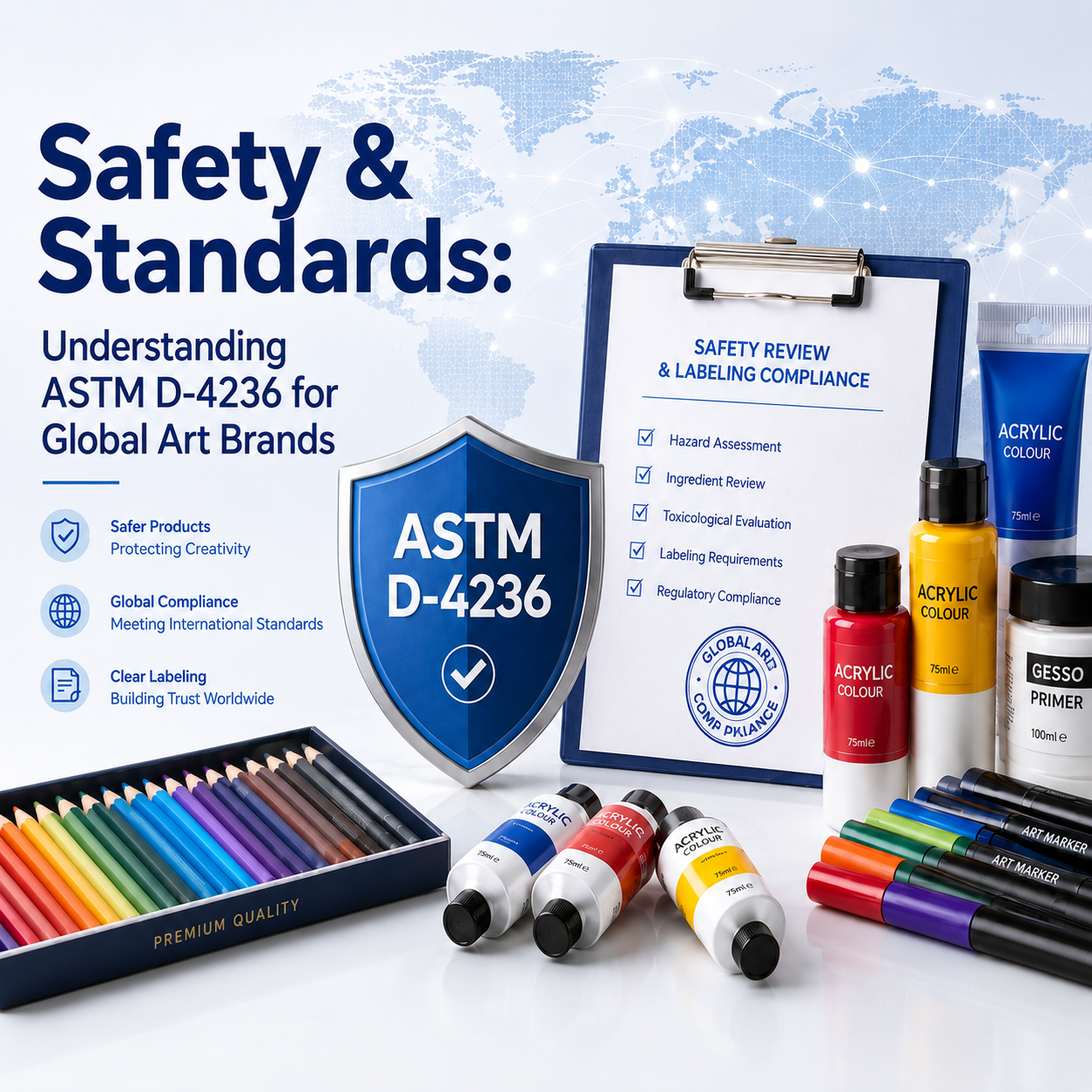
Safety & Standards: Understanding ASTM D-4236 for Global Art Brands

Summary

A comprehensive guide to ASTM D-4236, EN71-3, and international safety certifications for art supplies — what they mean for manufacturers, importers, and private label brands.

Safety & Standards: Understanding ASTM D-4236 for Global Art Brands
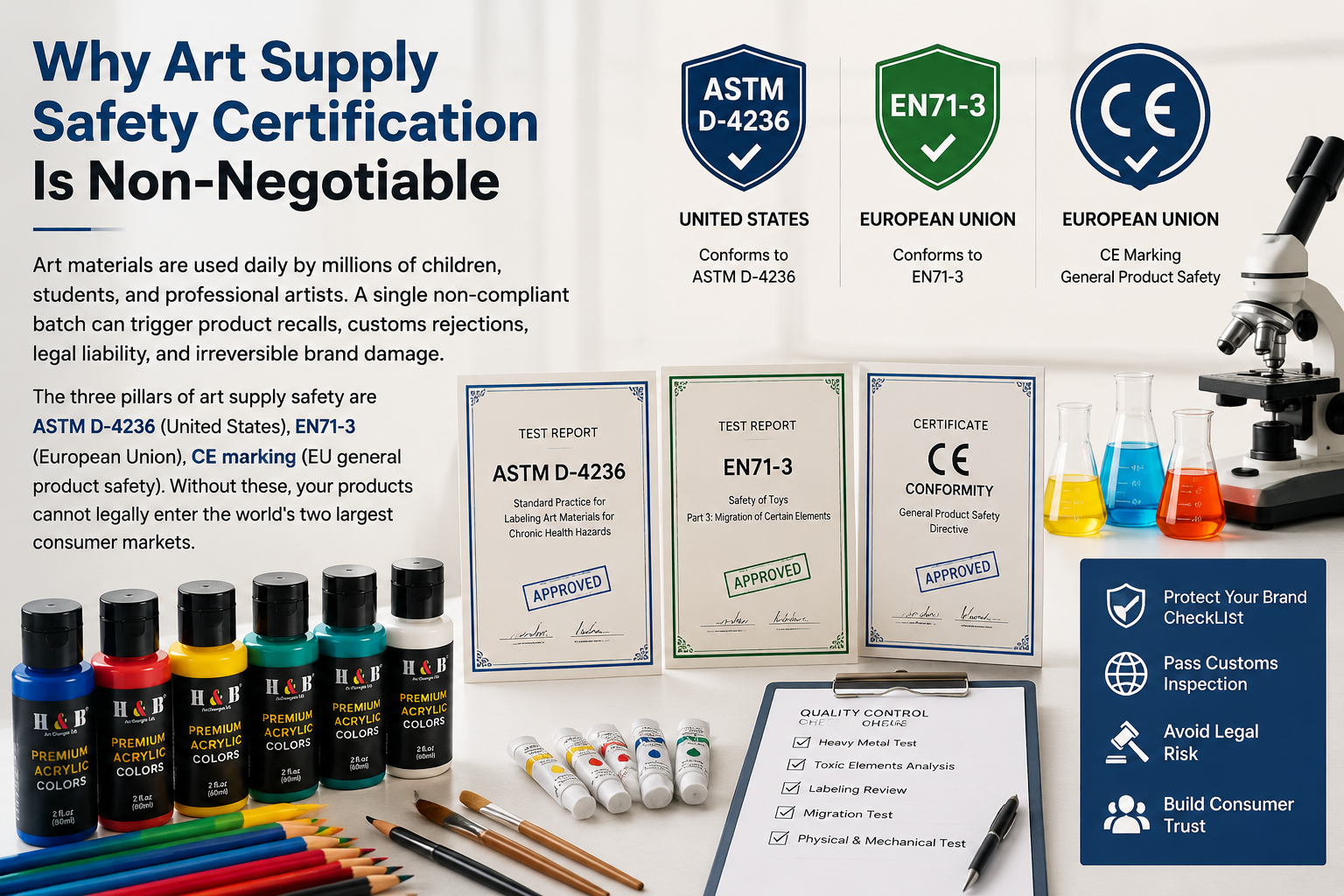
Why Art Supply Safety Certification Is Non-Negotiable

Art materials — from colored pencils to acrylic paints — are used daily by millions of children, students, and professional artists. A single non-compliant batch can trigger product recalls, customs rejections, legal liability, and irreversible brand damage. For importers, distributors, and private label brands sourcing from overseas manufacturers, understanding international safety certifications is not a compliance checkbox — it is the foundation of market access. The three pillars of art supply safety are ASTM D-4236 (United States), EN71-3 (European Union), and CE marking (EU general product safety). Without these, your products cannot legally enter the world's two largest consumer markets.

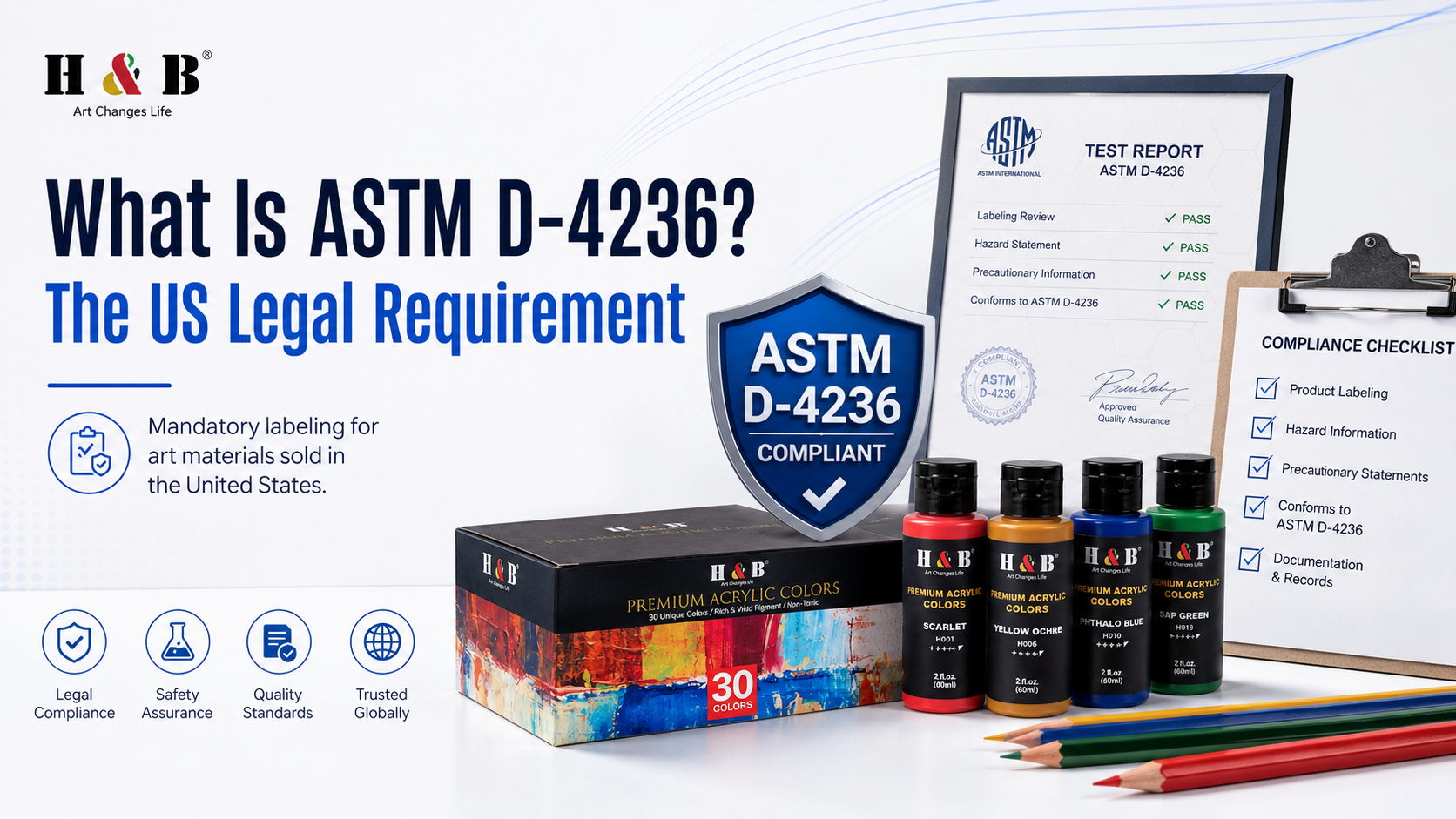
What Is ASTM D-4236? The US Legal Requirement

ASTM D-4236 is the Standard Practice for Labeling Art Materials for Chronic Health Hazards, established by ASTM International and mandated by the US federal Labeling of Hazardous Art Materials Act (LHAMA). In simple terms: every art material sold in the United States — paints, pencils, markers, clay, pastels, glue, chalk — must be evaluated by a qualified toxicologist and labeled with the statement 'Conforms to ASTM D-4236' if no chronic hazards are found. This is not optional compliance; it is federal law. Products that fail to carry this label are subject to seizure by US Customs and Border Protection, fines from the Consumer Product Safety Commission (CPSC), and removal from Amazon and retail shelves.

The Toxicological Evaluation Process: How Products Get Certified

ASTM D-4236 certification requires a board-certified toxicologist to review every ingredient in an art material's formulation. The toxicologist evaluates chronic health hazards — long-term risks such as carcinogenicity, neurotoxicity, reproductive toxicity, and developmental toxicity — rather than just acute risks like immediate skin irritation. This distinguishes ASTM D-4236 from simpler 'non-toxic' claims that only address short-term exposure. For art supply manufacturers, this means maintaining detailed Safety Data Sheets (SDS) for every raw material, submitting formulations to accredited testing laboratories, and updating certifications whenever formulations change. The process typically takes 2-4 weeks per product and costs $500-$2,000 depending on complexity.

EN71-3 and CE Marking: The European Counterpart

For products entering the European Union, EN71-3 is the equivalent safety standard — specifically Part 3 of the European Standard on Safety of Toys, which governs the migration of certain elements (heavy metals) from toy materials. While EN71 technically covers toys, its scope extends to any product 'intended for use in play by children under 14 years,' which captures the vast majority of art supplies. Combined with CE marking — the manufacturer's declaration that a product meets all applicable EU health, safety, and environmental requirements — EN71-3 is the gateway to the 27-country EU market. Products that carry both ASTM D-4236 and EN71-3 certification are effectively cleared for sale in North America and Europe, covering approximately 60% of the global art supply market by value.

AP Non-Toxic Seal: The Consumer-Facing Trust Mark

Beyond regulatory requirements, the Art & Creative Materials Institute (ACMI) administers the AP (Approved Product) Non-Toxic Seal program. Products bearing the AP seal have been evaluated by ACMI's toxicological team and certified to contain no materials in sufficient quantities to be toxic or injurious to humans, including children. While the AP seal is voluntary, it carries significant consumer trust — parents and teachers actively look for it when purchasing art supplies for children. For brands selling through Amazon, the AP seal can be displayed in product images and A+ content, providing an immediate visual trust signal that differentiates your listing from uncertified competitors.


The Cost of Non-Compliance: Real Consequences

Failure to comply with ASTM D-4236 and EN71-3 is not theoretical. In 2023, a major US retailer recalled over 50,000 units of imported crayons after CPSC testing found lead levels exceeding federal limits — the recall cost exceeded $2 million in logistics, refunds, and legal fees alone, not including permanent brand damage. Amazon enforces these standards through its Compliance Reference tool; listings flagged for missing certification documents are removed within 24 hours and sellers face account-level suspension for repeat violations. For B2B importers, non-compliant shipments are detained at port by US Customs, accumulating storage fees of $200-$500 per day until resolved or destroyed. The math is simple: a $1,000 certification investment protects against a $50,000+ compliance failure.

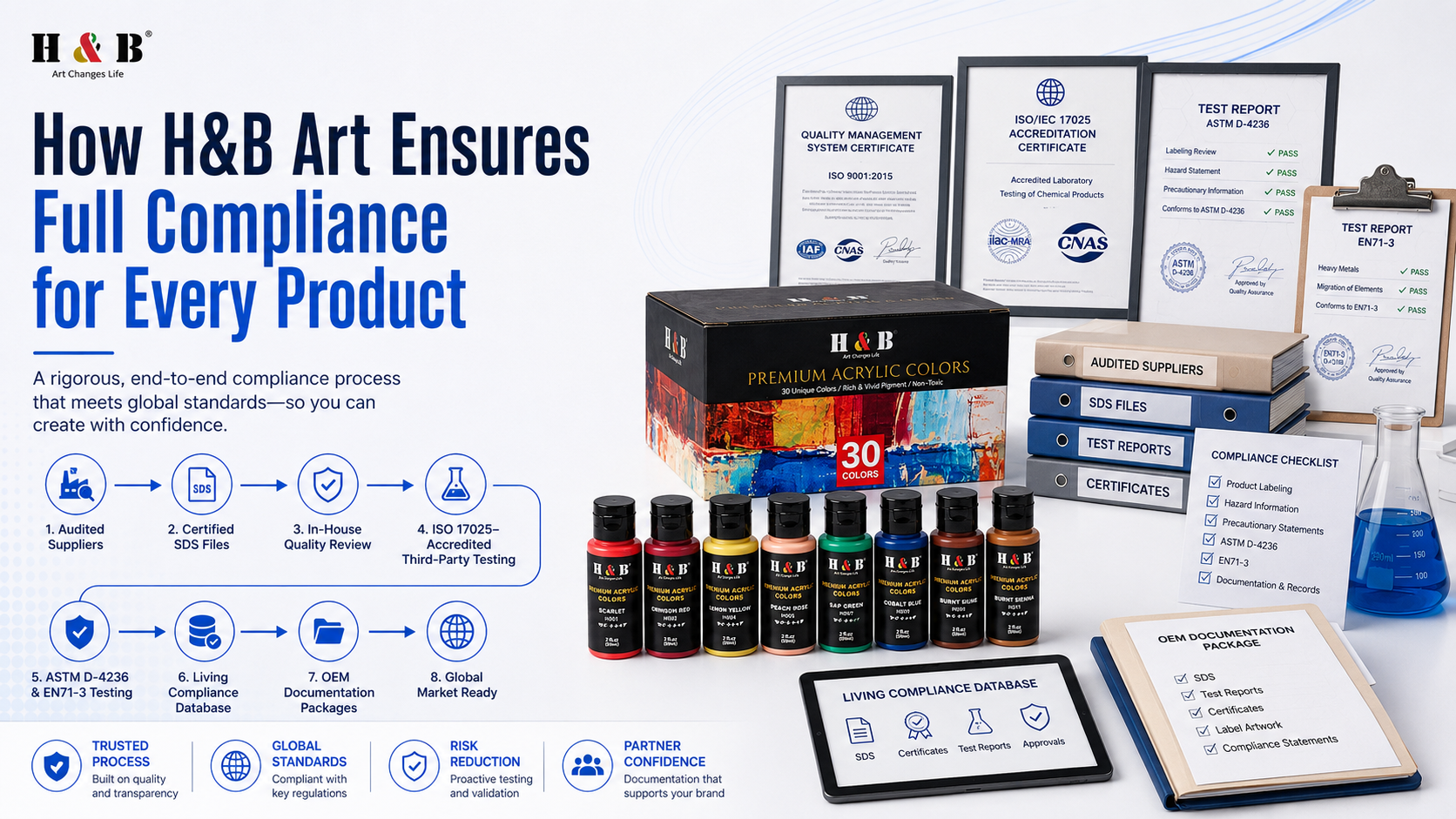
How H&B Art Ensures Full Compliance for Every Product

At H&B Art, safety compliance is built into our manufacturing process at the raw material stage — not tested after production. Every pigment, binder, and additive we use is sourced from audited suppliers who provide certified Safety Data Sheets. Before any new product enters mass production, our in-house quality team submits samples to ISO 17025-accredited third-party laboratories (including SGS, TÜV Rheinland, and Intertek) for ASTM D-4236 and EN71-3 testing. We maintain a living compliance database for all 300+ SKUs, updated annually or whenever a formulation changes. For OEM and private label clients, we provide the full compliance documentation package — test reports, certificates, SDS files, and CE declarations of conformity — ready for submission to Amazon, customs authorities, and retail buyers.

Beyond ASTM D-4236: H&B's Additional Certifications

While ASTM D-4236 and EN71-3 form the baseline, H&B goes further with additional certifications that strengthen our partners' market position: FSC Certification for wooden pencils, verifying responsible forest sourcing that appeals to eco-conscious consumers and meets EU Timber Regulation requirements; SGS Factory Audit, an independent verification of our manufacturing facility's quality management, social compliance, and production capability; BSCI Social Compliance, demonstrating ethical labor practices that are increasingly required by European retail chains; and ISO 9001 quality management certification. Together, these certifications tell a complete story — not just 'our products are safe,' but 'our factory, our people, and our supply chain meet world-class standards.'

What OEM Buyers Should Ask Manufacturers About Safety Certifications

When evaluating OEM art supply manufacturers, asking the right questions separates reliable partners from compliance risks. 1. 'Can you provide current, third-party ASTM D-4236 and EN71-3 test reports for the exact product I am ordering?' — note the emphasis on 'current' (within 12 months) and 'third-party' (not in-house testing). 2. 'What happens to compliance documentation if you change your pigment or binder supplier?' — the answer reveals whether the manufacturer has a formal re-certification process or cuts corners. 3. 'Do you have an in-house toxicologist or a standing contract with an accredited lab?' — manufacturers who invest in ongoing toxicological relationships produce more consistent results. 4. 'Can I list these certifications on Amazon and in my retail packaging?' — some manufacturers provide test reports that are not intended for public-facing use; ensure your OEM agreement includes the right to use certification language on packaging and listings.

Checklist for Entering the US and EU Art Supply Markets

For US market entry: ASTM D-4236 toxicological evaluation (mandatory), CPSC compliance documentation, AP Non-Toxic seal from ACMI (recommended), CPSIA tracking labels for children's products (if applicable), California Proposition 65 compliance (if applicable). For EU market entry: EN71-3 heavy metals migration testing (mandatory for products targeting children), CE marking with full technical documentation, REACH regulation compliance for chemical substances, EU Toy Safety Directive 2009/48/EC (if applicable), FSC or PEFC certification for wood products (recommended). For both markets: ISO 17025-accredited laboratory reports, product liability insurance, and a documented quality management system. Importers who present this documentation suite to customs authorities and retail buyers dramatically reduce time-to-market and eliminate compliance-related delays.
Conclusion: Safety Certifications Are a Competitive Advantage, Not a Cost
In the global art supply industry, safety certifications do not just protect against legal risk — they open doors. Amazon's algorithm favors listings with documented compliance. Retail chain buyers filter supplier applications by certification status before reading a single product description. Schools and educational institutions in the US and EU will not purchase uncertified art materials, period. For H&B Art and our OEM partners, ASTM D-4236, EN71-3, and our broader certification portfolio are the foundation of trust with every customer — from the parent buying a first set of colored pencils for their child, to the procurement director placing a 50,000-unit order for a national school system. When you partner with H&B, you are not just buying products; you are buying market access, legal protection, and the confidence that every product bearing your brand meets the world's highest safety standards.